
 Laser Hair Reduction
 Hair Re-Growth
 Acne / Scar
 Skin Rejuvenation
 Insta Glow Solutions
 Pigmentation
 Anti-Aging
 More
 Body


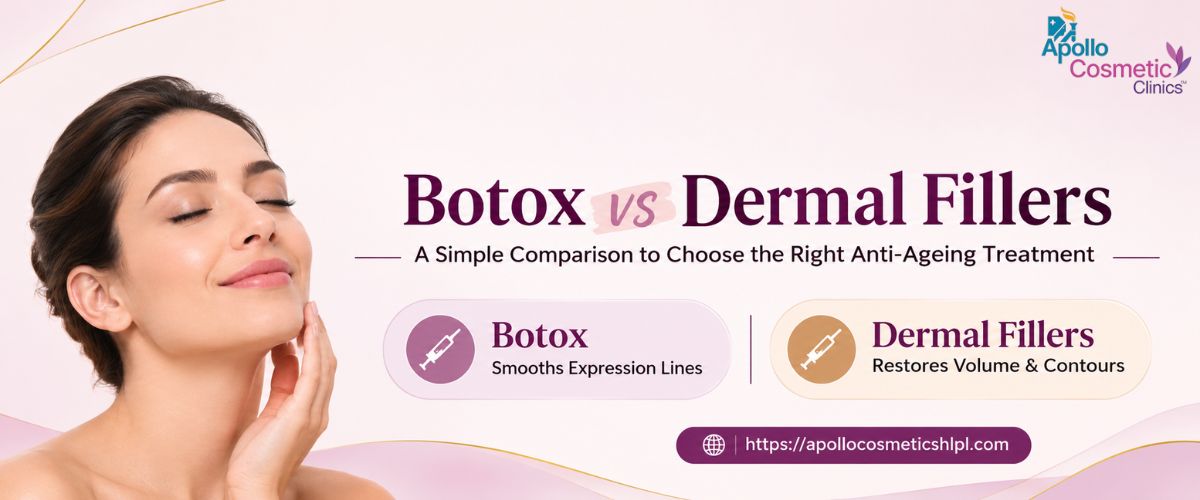
As you age, your skin undergoes changes. It happens gradually, little by little, until you are left with sagging, wrinkled and dull skin. At times, you can observe less elasticity with fine lines popping up. In such cases, you can benefit from cosmetic treatments. Options like Botox and dermal fillers can be highly effective. Both of these are popular non-surgical treatment options, offering anti-ageing benefits. Find out which type of anti-ageing treatment will be right for you.
What are the Benefits of Botox Treatment?
Botox is one of the most popular ways to flaunt your facial skin. Many people like to go for this type of treatment to restore volume to their face, making their skin taut. Today, it is a top choice for many who want to restore youthful appearance and consider age as just a number.
Botox can help in:
Relaxing facial muscles,
Softening dynamic wrinkles such as forehead lines, crow’s feet and frown lines
Preventing new wrinkle formation, and
Contouring and lifting the face
However, you have to understand that the results are usually temporary and after every 3 – 4 months, you need to go for repeat treatments. Only then, you will be able to maintain the results from your first session.
You can also get some other benefits from Botox treatment, such as:
Reducing the frequency of severe migraine,
Alleviating muscle disorders and spasms,
Treating muscle imbalances causing strabismus (lazy eye),
Getting relief from excessive sweating (Hyperhidrosis), and
Calming an overactive bladder
Generally, the process is safe enough when an experienced, careful and qualified healthcare provider is in charge. Even then, you may suffer from temporary side effects, including:
Localised muscle drooping,
Swelling, or
Minor bruising
What Do You Need to Know About Dermal Fillers?
This is another popular cosmetic treatment that people like to undergo when they age. Dermal fillers are substances similar to gel. These are injected beneath the skin to ensure anti-ageing benefits. These include:
Restoring lost volume,
Smoothening folds and wrinkles,
Stimulating production of collagen, and
Enhancing facial contours
You can get instant results with this type of treatment. Further, you have to experience minimal downtime. Right after undergoing this treatment, you can notice visible improvements. You can also get reversible options. If there is a need for any adjustment, an enzyme called hyaluronidase can be used to dissolve Hyaluronic fillers.
Most of these fillers are temporary in form. Your body will absorb these gradually. With dermal fillers, you can add volume under your skin. It can enhance your lips, under-eye areas, chin and cheeks. It can also smoothen your static lines.
Most people are able to go back to their usual routine or activities immediately after undergoing dermal filler sessions. They only suffer from mild swelling or bruising. It is a good idea to discuss proper administration and safety risks and choose a board-certified dermatologist or plastic surgeon.
Botox vs Dermal Fillers
Both of these are non-surgical injectable treatments. However, these work in different ways. These can target distinct signs of ageing.
In case of Botox, a neuromodulator (onabotulinumtoxinA) is injected into muscles to temporarily block nerve signals. It can relax the particular muscles that cause dynamic wrinkles. These are the lines that are formed by repetitive facial expressions such as smiling or squinting.
Dermal Fillers are different. Gel-like substances, which are often composed of hyaluronic acid, is directly injected under your skin. It can smoothen static wrinkles or the lines that are visible even when your face is in a resting stage.
Botox mainly targets the dynamic wrinkles. It takes care of forehead lines, crow’s feet and frown lines (“11” lines). It can relax and “freeze” your muscles. The results show up in 3 to 7 days, while you can observe the full effect in 1 to 2 weeks. The effects can last for around 3 – 4 months.
Dermal fillers address static wrinkles and loss of volume. These take care of lips, under-eye area, jawline, nasolabial folds and cheeks. Fillers can lift, fill and plump your tissues. The results, unlike Botox, are immediately visible. The effects last longer too. You can find the outcomes lasting anywhere between 6 months to 2 years. However, the kind of product used for the session will actually determine how long you can expect the results to last.
Which Anti-Ageing Treatment Is Right for You?
If you want to soften expression lines on the upper face or prevent new creases from deepening, you should go for Botox treatment. However, if you want to restore lost facial volume, lift sagging contours, or plump thin lips, dermal fillers are what you should go for.
It is also noteworthy that many people like to use both types of treatments today, as part of a combined treatment plan. It can help them to address various parts of their face. Before going for any type of treatment, you should tell your dermatologist clearly about your intended purpose. Have a defined goal as to what you exactly want. A consultation with an expert dermatologist will help you to move towards the right direction.
You also need to read reviews, pros and cons of each type of treatment. It will allow you to find out about the benefits of each cosmetic treatment option. Weigh the pros and cons with full acuity, be informed before you take the final call before availing a treatment.
Conclusion
Both Botox and dermal fillers can be useful cosmetic options. Before you go for any type of treatment, you should have a clear idea about what each of these can provide you with. You should have a proper discussion with an expert dermatologist who has a lot of experience in offering both types of treatment. You can discuss your needs, find out what kind of results you can expect, which practical aspects you must take care of and how your treatment will proceed. It is a good idea to get in touch with an expert, board-certified dermatologist who can provide you with the safest and best outcomes.
